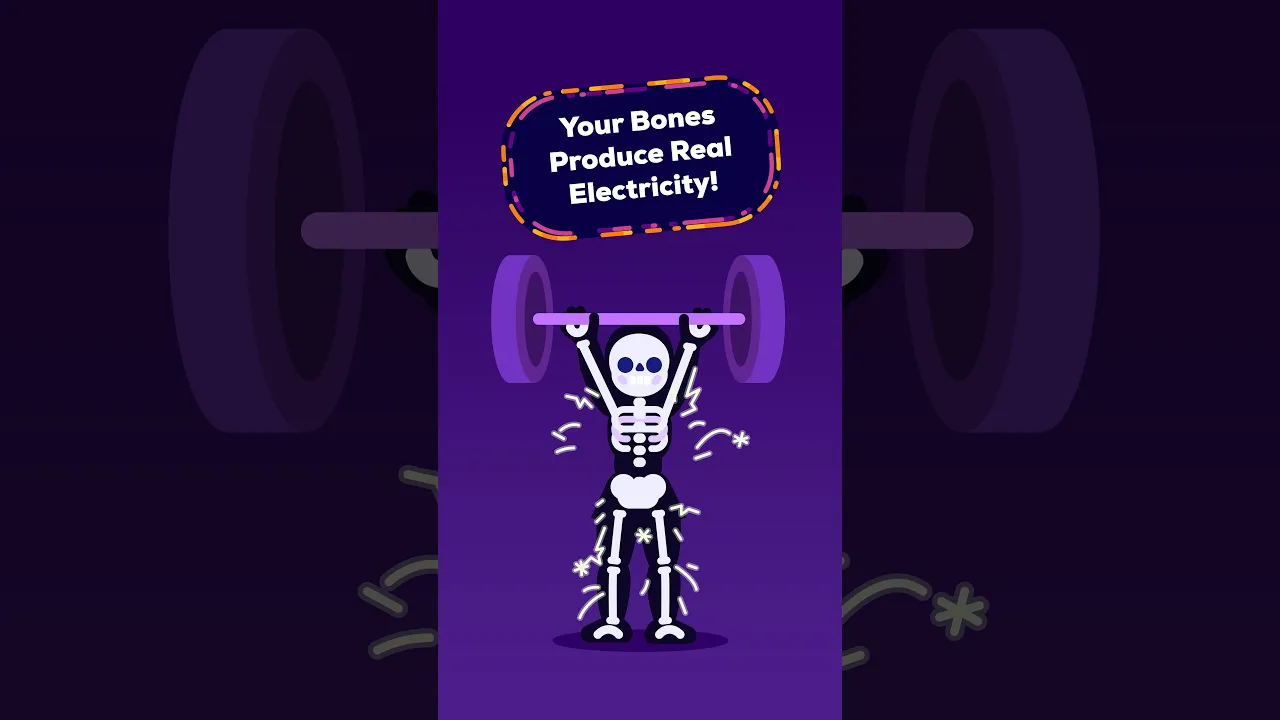

Pick up your pace on your next run, and you trigger an unseen bioelectric response beneath your skin. While you cannot harvest this internal energy to recharge your personal electronics, your skeleton relies on it to gauge where it must fortify its own architecture.
Far from serving as rigid, lifeless scaffolding, human bone remains in a perpetual state of dynamic equilibrium. Whenever you sprint, lift weights, or simply step off a curb, external loads deform the bone matrix on a microscopic scale. This subtle mechanical strain pulls on collagen fibrils and shifts fluid through minute canals, provoking the piezoelectric phenomenon alongside electrokinetic streaming potentials. Essentially, bone translates mechanical force directly into localized electrical fields. These negative and positive charges dictate the cellular dialogue between bone-resorbing osteoclasts and bone-forming osteoblasts. Under high mechanical load, the resulting electrical gradients stimulate cellular receptors, instructing osteoblasts to synthesize new collagen and lay down calcium phosphate crystals. Orthopedic researchers have long connected this dynamic to Wolff’s Law, which states that healthy bone adapts to the loads placed upon it. Without this continuous mechanical stimulation, such as during extended bed rest or orbital spaceflight, osteoblast activity wanes dramatically. The body rapidly sheds unneeded mineral content, leading to pronounced fragility and bone thinning. Your daily habits dictate whether this bioelectric circuitry orders reinforcement or allows structural decay.
Ultimately, your skeleton behaves like responsive organic hardware that constantly updates its structural profile based on mechanical input. Every stride you take delivers the bioelectric stimulus necessary to keep your frame resilient against future impact.

