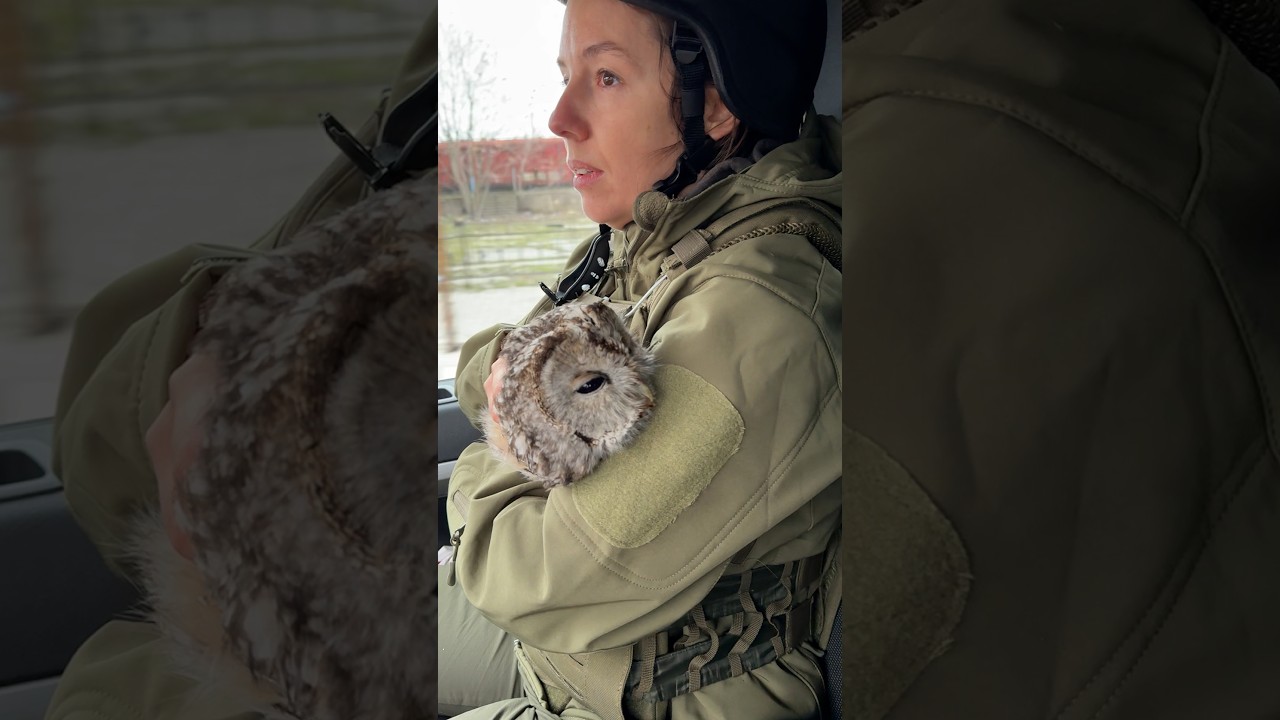

Warfare relentlessly redraws the boundaries of danger, turning mundane airspace into a gauntlet for local fauna. Suspended high above contested terrain, industrial nylon designed to thwart loitering munitions recently ensnared an unassuming raptor whose nocturnal flight paths collided with human strife.
The bird—a diminutive specimen easily dwarfed by ordinary defensive gear—became hopelessly pinned when she struck an anti-drone net. With each futile spasm, the synthetic cords cut tighter into her delicate joints, leaving her vulnerable to the elements and sudden predation. Her survival hung entirely on the awareness of personnel stationed nearby, who swiftly alerted Vet Crew practitioners Dr. Valentina and Dr. Leonid. Reaching the site under grueling regional conditions, the veterinary team had to disentangle the thrashing raptor before severe necrosis set in. Operating with measured composure, they severed the load-bearing strands without inflicting secondary trauma to her primary wing surfaces. Back in their intensive care facility, the doctors conducted an exhaustive diagnostic regimen, identifying soft-tissue contusions and acute systemic exhaustion. Staff monitored her vital signs, ensuring no latent fracture compromised her skeletal alignment while administering targeted analgesics and fluid therapy. Over consecutive days of convalescence, the owl regained her defensive posture, preening her damaged mantle and greedily consuming nourishment. Such field operations demonstrate how wildlife clinicians confront the ecological carnage trailing mechanized conflict.
While combat systems evolve at breakneck speed, wild creatures remain bound to ancestral flight paths. Watching this tiny survivor regain her strength offers an evocative glimpse of ecological endurance amidst mechanical chaos.

